

Every rider knows the sentence that is coming. “He came out of nowhere.” A driver turns left across your lane, never looks, and then describes your speed as though he had been watching you the whole time.
Zavodnick & Lasky Personal Injury Lawyers handles motorcycle crash claims in Philadelphia, and a large part of that work is dismantling an account of the crash that was assumed rather than observed. Call +1 (215) 875-7030.
Does Not Wearing a Helmet Hurt Your Claim in Pennsylvania?
It does not decide who caused the crash, and in Pennsylvania many riders are not required to wear one at all.
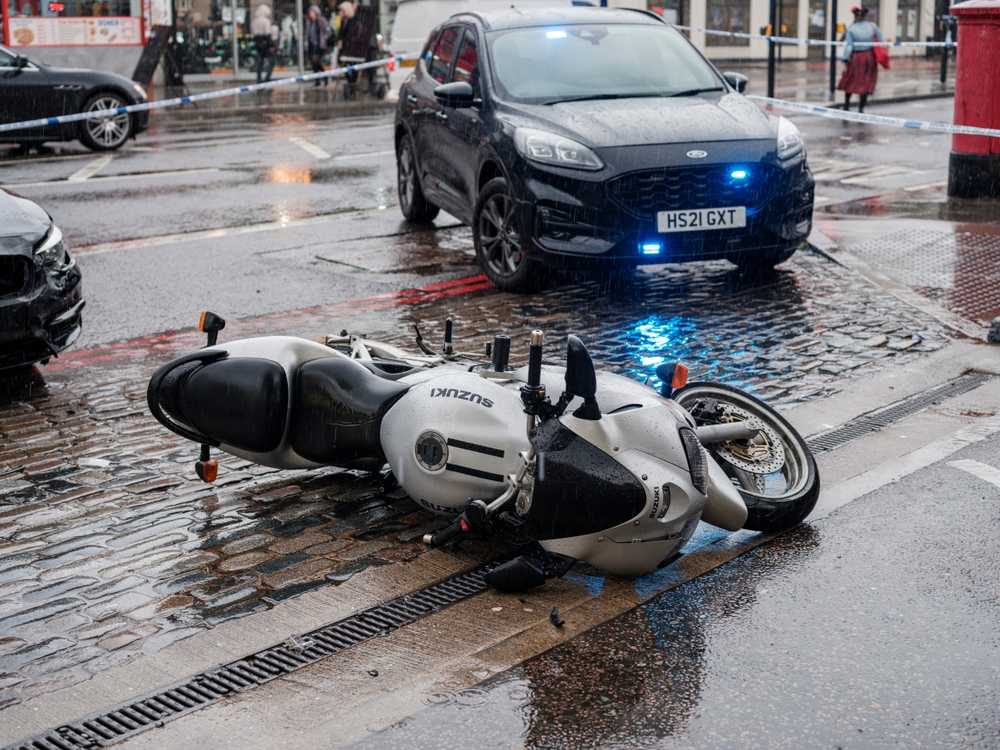
Under 75 Pa.C.S. § 3525, riders under 21 must wear approved headgear. Riders 21 and over may ride without a helmet if they have been licensed to operate a motorcycle for at least two years or have completed an approved motorcycle safety course. Eye protection requirements apply separately.
So a rider lawfully riding without a helmet has broken no rule. Insurers raise it anyway, because it works on people who assume it is a defense. It is not a defense to liability, and helmet choice has nothing to do with which vehicle failed to yield.
Where it can come up is narrower: an argument about whether a specific head injury would have been less severe. That is a medical question answered by medical evidence, and it does not touch the rest of the claim, including the orthopedic injuries that make up most of what riders actually suffer.
Our page on Pennsylvania motorcycle helmet laws covers the requirements in detail, and motorcycle licensing requirements covers the endorsement rules.
If an adjuster has already brought up your helmet, call +1 (215) 875-7030.
Why Do Riders Get Blamed for Crashes They Did Not Cause?
Because the assumption arrives before the evidence does. Officers, adjusters and jurors carry an idea about how motorcyclists ride, and in a crash with no independent witness that assumption fills the gap.
The most common scenario in Philadelphia is a left-turning driver who crosses in front of an oncoming motorcycle and then says the rider came out of nowhere or must have been speeding. Both statements describe the driver’s own failure to look. Neither is evidence.
What answers it is reconstruction rather than argument: the throw distance, the point of impact on both vehicles, the sightlines from the driver’s seat, the signal timing at that intersection, and whatever footage exists nearby. Speed can be calculated. Perception is not the same as proof.
How Does Pennsylvania Divide Fault in a Motorcycle Crash?

Pennsylvania applies modified comparative negligence under 42 Pa.C.S. § 7102. At 50% or less you recover, reduced by your percentage. At 51% or more you recover nothing.
An example makes the arithmetic concrete. If you are assigned 20% of the fault and your damages come to $100,000, you recover $80,000. If the same adjuster pushes that number to 51%, you recover nothing at all.
That cliff is exactly why insurers work so hard on rider fault, and why the physical evidence in these cases carries more weight than in an ordinary collision, see our case results for examples of how that plays out..
One more thing riders are rarely told: motorcycles are not private passenger motor vehicles for limited tort purposes, so a rider is generally not restricted by a tort election in the way a car occupant is.
What Puts Riders Down on Philadelphia Streets?
The hazards that injure riders in this city are mostly not other riders’ mistakes.
Trolley tracks and rail. In West Philadelphia and along the surface routes, embedded rail and the gap beside it catch a front tire, particularly in the wet. A rider can go down without any vehicle touching them.
Pavement condition. Utility trench cuts, sunken castings, potholes and steel plates. What a car absorbs, a motorcycle does not.
Left-turning vehicles. The single most common serious crash type, at intersections where a driver misjudges an approaching bike’s speed and distance.
Doors and double-parked vehicles. Riders passing a stopped line of traffic on Broad, Market or Passyunk.
Bridge decks and expansion joints. The Schuylkill and Delaware crossings have surfaces that behave very differently for two wheels.
Statewide crash data is published by PennDOT, and national rider safety research is maintained by NHTSA.
Who Can Be Held Responsible for a Philadelphia Motorcycle Crash?

Anyone whose negligence contributed, and often more than one party.
- Drivers of cars and passenger vehicles
- Other motorcyclists
- Bicyclists and pedestrians
- Bus drivers and transit companies
- The employer of a driver who was working at the time
- The manufacturer of a defective vehicle component or piece of safety equipment
- A government body responsible for a hazardous road condition
That last one runs on a much shorter clock. A claim involving a public agency can require written notice within six months rather than two years, which is covered further down.
How Will a Lawyer Help After a Motorcycle Crash?
By getting to the evidence before it degrades, and by refusing to let the first account of the crash become the accepted one.
When you hire our Philadelphia motorcycle accident attorneys, we will:
- Preserve the bike, the damage pattern and any available footage before anything is repaired or overwritten
- Retain reconstruction witnesses where speed or sightlines are in dispute
- Investigate every party who contributed, including employers and public bodies
- Handle the insurers and the recorded-statement requests
- Push back when the defense tries to shift fault onto you
We can meet you at home, at work or in the hospital if getting to an office is not realistic right now. Call +1 (215) 875-7030.
What Can You Recover After a Motorcycle Accident?
Riders take the full force of a collision, so the injury profile is heavier than in a car crash: lost limbs, broken bones, crush injuries, head and brain injuries, spinal cord damage, paralysis, burns and wrongful death.
Damages can include:
- Medical expenses, current and future
- Rehabilitation and nursing care
- Property damage
- Lost wages and reduced earning capacity
- Disability
- Pain and suffering
- Emotional distress
- Disfigurement and scarring
- Loss of enjoyment of life
Valuing this properly means accounting for what the injury will cost you over the next twenty years, not just what it has cost so far. For a rider with a permanent orthopedic injury, that future number is usually the larger one.
How Long Do You Have to File?
Two years from the date of the crash for most Pennsylvania injury claims. If the statute of limitations expires before a claim is filed, the right to bring it is gone regardless of how strong the case was.
The exception worth flagging: if a SEPTA vehicle, the city, or another public body was involved, written notice is generally required within six months. Riders who went down on a poorly maintained road surface fall into this category and frequently do not realize it.
What Riders Ask After a Crash
Does my motorcycle insurance include the same medical benefits as a car policy?
Not automatically. Pennsylvania does not require the same first-party medical benefits on a motorcycle policy that it requires on an auto policy, so riders frequently discover after a crash that the medical coverage they assumed exists does not. Checking your declarations page, and any auto policy in your household, is worth doing before you need it.
I went down on trolley tracks or a pothole and no car was involved. Do I have a claim?
Possibly, against whoever was responsible for maintaining that surface. These claims are narrow, they require proof that the condition went beyond a normal defect and that the responsible body knew about it, and they usually run on a six-month notice deadline rather than two years. They cannot sit.
The driver who hit me says I was lane splitting. Does that end my claim?
No, though it complicates it. Lane splitting is not permitted in Pennsylvania, but a rider’s own conduct only reduces recovery in proportion to fault, and it bars recovery only above 50%. Drivers describe ordinary lane positioning as lane splitting all the time, and where the bike actually was is a question of evidence.
What happens to my bike while the claim is pending?
Do not repair it or dispose of it before it has been documented. The damage pattern is evidence of impact angle and speed, and it is frequently the strongest physical proof available. Photograph it thoroughly from all sides, and if a total loss is declared, ask the insurer to hold it or arrange for it to be inspected first.
Before the Other Side’s Version Becomes the Record

The account a driver gives at the scene is the one everybody works from unless somebody challenges it. Challenging it takes physical evidence, and physical evidence in these cases is a bike that has not been scrapped and footage that has not been overwritten.
Call Zavodnick & Lasky Personal Injury Lawyers at +1 (215) 875-7030 and tell us where the bike is.
Related reading: Philadelphia car accident lawyer for the citywide motor vehicle practice.
Reviewed by the motor vehicle team at Zavodnick & Lasky Personal Injury Lawyers, which handles motorcycle crash claims in Philadelphia County and the surrounding counties.
