

Injuries from a collision with a container truck are rarely minor, and the companies behind that truck respond within hours. Zavodnick & Lasky Personal Injury Lawyers represent people hurt in those crashes throughout South Philadelphia.
South Philadelphia carries port freight, and port freight moves differently than highway freight. Containers come off ships at the Packer Avenue terminal and onto chassis that were loaded by someone other than the driver, hauled by carriers working short runs under tight turn times, onto I-95 ramps and Columbus Boulevard alongside ordinary traffic.
That chain is why a crash here can involve companies that were never at the scene. Call (215) 875-7030.
Who is responsible when a container truck causes a crash?
Frequently more than the driver and the trucking company. A container loaded unevenly or over weight, secured badly, or fitted to a chassis with worn brakes can cause a crash that looks like driver error on the police report.
| Where the failure happened | Who may answer for it |
| Behind the wheel | The driver |
| Hiring, scheduling, maintenance | The motor carrier |
| Loading, weight, securement | The shipper or loading company |
| Chassis brakes, tires, lights | The equipment owner or maintenance contractor |
| Choosing the carrier | The freight broker, in some circumstances |
Sorting that out requires the bill of lading, the weight tickets, the chassis inspection history and the carrier’s maintenance file. None of that arrives on its own, and some of it is on a retention schedule.
The roads where these crashes happen
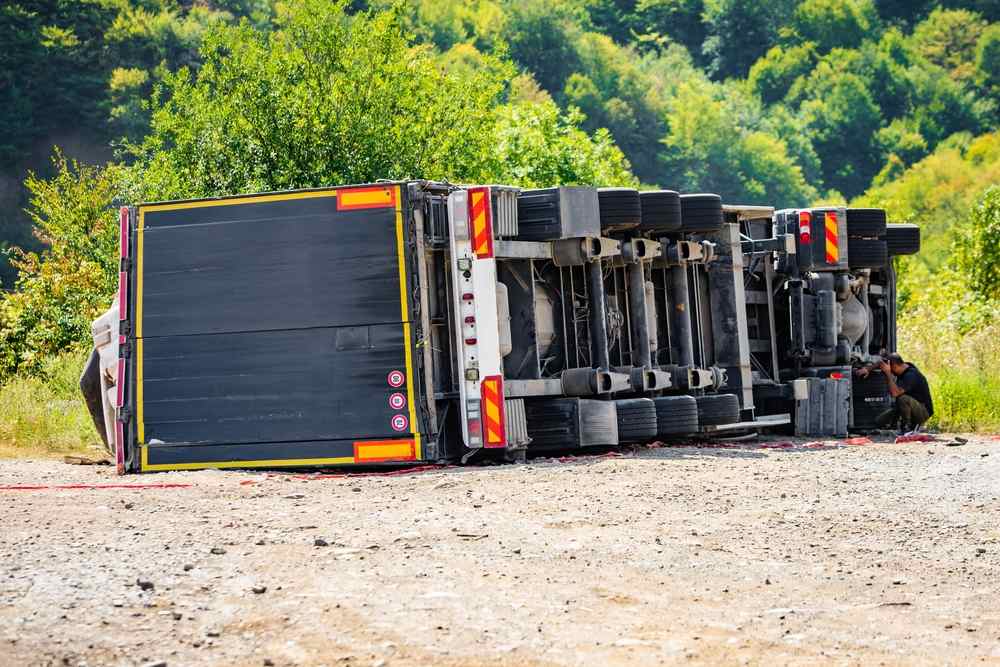
The I-95 ramps at Packer and Columbus, where trucks merge into traffic moving at highway speed. Oregon Avenue and Front Street, where trucks feed in and out of the terminal district. The approaches to the Walt Whitman Bridge. Columbus Boulevard on a Saturday with stadium traffic layered over freight.
Inside the neighborhood the problem changes shape. Delivery trucks work narrow one-way blocks between parked cars, with no room to correct a bad turn and sightlines that end at the corner. A truck reversing mid-block on a street built for horses is a pedestrian case waiting to be written.
If that describes your crash, call (215) 875-7030.
How fast does evidence go away?
Fast enough that it drives the schedule of the case. Federal rules require carriers to retain hours-of-service records and supporting documents for six months. Video from the tractor, from the terminal gate, and from businesses along the route runs on much shorter loops, sometimes days.
Preservation demands go out first, to the carrier, the equipment owner and any business whose camera may have caught the approach. Where a terminal or a public agency holds footage, the request needs to go to the right custodian quickly, because nobody holds video for a claim they have not heard about.
Does the port setting change the claim?

It can. Work around marine terminals brings in longshore and maritime rules that do not apply to ordinary highway crashes, and a dockworker hurt on the terminal may have a different benefits route than a truck driver hurt on Columbus Boulevard.
For the driver of a passenger car hit by a container truck, the claim runs the ordinary way: a negligence case against the driver and the companies behind him. The reason to raise the distinction is that the wrong assumption about which system applies costs time on deadlines that do not forgive it.
Where the case is filed and what it is worth arguing about

A crash in South Philadelphia belongs in the Philadelphia County Court of Common Pleas, with its Trial Division at City Hall, and smaller claims can be handled in Municipal Court. Where a carrier regularly does business elsewhere, venue can open up, which is a question worth asking rather than assuming.
The other early question is coverage. Under 49 CFR Part 387, a for-hire carrier hauling ordinary freight in interstate commerce must carry at least $750,000 in liability coverage, and a container operation can involve several insured companies at once. For injuries that outrun one policy, identifying every insurer in the chain is the difference between a settlement that covers the future care and one that stops at the hospital bills.
If you chose limited tort on your own policy, check what you were riding in when the crash happened. Under 75 Pa.C.S. § 1705, a person injured while occupying a motor vehicle other than a private passenger car keeps full tort rights, which reaches workers hurt while riding in a truck or van on the job. Our limited tort page covers the exceptions.
What South Philadelphia clients ask first
A truck hit my parked car while I was in it, is that a claim?
Yes. Injuries from a low-speed impact by a heavy vehicle are real and documented every day, and the vehicle’s weight is what separates that crash from being tapped by a sedan.
The driver said he was an owner-operator, so is the company off the hook?
Not necessarily. Owner-operators usually haul under a motor carrier’s federal authority, and that relationship can put the carrier on the claim regardless of who owns the tractor.
I did not go to the hospital that day, did I ruin my case?
No, though the gap gets argued. Get evaluated now, tell the provider the crash caused it, and keep the treatment consistent from here forward.
Put a lawyer on it before the equipment is back in service

A tractor and chassis that caused a crash are usually back on the road within days, and the physical evidence goes with them. The investigation has to start while the pieces still exist.
Zavodnick & Lasky Personal Injury Lawyers take South Philadelphia truck cases on a contingency basis, so the fee comes out of what is recovered. Call (215) 875-7030. See also our Philadelphia truck accident page and our South Philadelphia car accident page.
